

Nasal Congestion & Blocked Nose Treatment
Nasal Congestion & Blocked Nose Treatment in Dhaka
Finding it hard to breathe through your nose? At Malleus ENT Specialized Hospital, our ENT team looks for the cause of your blocked nose — from allergy and enlarged turbinates to polyps, a deviated septum or enlarged adenoids in children — and plans care around what the examination finds.
- Experienced ENT specialists
- Modern diagnostic facilities
- Clear, personalised treatment plans

Understanding Nasal Congestion and Nasal Obstruction
Nasal congestion — a blocked or stuffy nose — happens when the lining of the nose swells or when something narrows the airway. Many people describe it as difficulty breathing through the nose, even when there is very little mucus.
Doctors use the term nasal obstruction for reduced airflow through the nose. A blocked nose with a cold usually settles by itself. A blockage that lasts for weeks, keeps returning, affects one side only, or disturbs your sleep needs a proper ENT examination, because the cause differs from person to person.
In Bangladesh, many patients say “naker mangsho berechhe” (নাকের মাংস বেড়েছে) — extra flesh in the nose. That phrase can mean several different conditions. This page explains the common ones so you know what to ask your doctor. It is part of our nose and sinus treatment in Dhaka services.
Not every blocked nose has the same cause
Allergy, infection, enlarged turbinates, a bent septum, polyps and enlarged adenoids can feel very similar. Treatment depends on which one is behind your symptoms — so an examination matters more than guessing from symptoms alone.
Common Symptoms of a Blocked Nose
These symptoms appear in several different conditions. They are a reason to get examined, not a diagnosis.
Persistent blocked nose
A stuffy feeling that lasts for weeks or keeps coming back.
Difficulty breathing through the nose
Needing to breathe through your mouth to get enough air.
One-sided nasal blockage
One side stays blocked for long periods while the other is clearer.
Night-time congestion
Blockage that gets worse when you lie down, with snoring or broken sleep.
Reduced sense of smell
Smell and taste feel dulled when the nose is blocked.
Mouth breathing and dry mouth
Waking with a dry mouth or throat, or noisy breathing, especially in children.
Common Causes of Nasal Obstruction
A blocked nose is a symptom, not a diagnosis. These are the causes ENT specialists most often consider.
Allergic rhinitis
Allergy to dust, pollen or pets swells the nose lining, often with sneezing, itching and a runny nose.
Non-allergic (vasomotor) rhinitis
Smoke, strong smells, weather changes or other irritants can trigger congestion without a clear allergy.
Infections and sinusitis
Colds and sinus infections cause swelling and mucus. Congestion that lingers or returns needs review.
Enlarged inferior turbinates
Normal structures on the side wall of the nose that can swell with allergy, irritation or infection.
Deviated nasal septum
A bent wall between the two nostrils can narrow one or both sides of the nose.
Nasal polyps
Soft, painless swellings from the lining of the nose or sinuses — different from turbinates. Read about nasal polyp treatment.
What Does “Extra Flesh Inside the Nose” Mean?
When patients say there is extra flesh in the nose, they are usually describing one of four things: enlarged turbinates, nasal polyps, enlarged adenoids (in children) or a bent septum. Each has a different treatment, which is why we examine first instead of guessing.
The most common is enlarged inferior turbinates (turbinate hypertrophy). Turbinates are normal, shelf-like structures along the inner side wall of the nose. Everyone has them. They warm and moisten the air you breathe, and they contain many blood vessels, so they can swell with allergy, irritation or infection. A swollen turbinate is not an extra growth, and not every large turbinate needs treatment.
Symptoms of enlarged nasal turbinates
- Blockage on one or both sides, sometimes switching sides
- Congestion that is worse at night or when lying on one side
- Poor airflow even when there is little mucus
- Snoring, mouth breathing and a dry mouth or nose
- Reduced sense of smell in some people

Enlarged Turbinates, Polyps, Adenoids or a Deviated Septum?
Four conditions that people often describe the same way. Only an ENT examination can tell them apart.
Enlarged turbinates
Where: Side wall of the nose.
What it is: Normal structures that have become swollen.
Typical features: Blockage that may switch sides or worsen at night.
Direction of care: Treat the cause and use medicines first. A procedure is considered only if blockage persists after proper treatment.
Nasal polyps
Where: Lining of the nose and sinuses.
What it is: Soft, painless swellings from inflamed lining.
Typical features: Constant blockage, reduced smell, nasal discharge.
Direction of care: Medical treatment first; surgery may be considered for selected patients.
Adenoid enlargement
Where: Behind the nose, at the back of the nasal cavity — not visible from the nostril.
Who: Mainly children.
Typical features: Mouth breathing, snoring, constant runny nose, repeated ear problems.
Direction of care: ENT assessment; options range from observation and medicines to surgery in selected children.
Deviated nasal septum
Where: The wall that divides the two nostrils.
What it is: A septum that is bent or shifted to one side.
Typical features: Constant one-sided (sometimes both-sided) blockage.
Direction of care: Surgery to straighten the septum may be considered if it causes symptoms despite medical care.
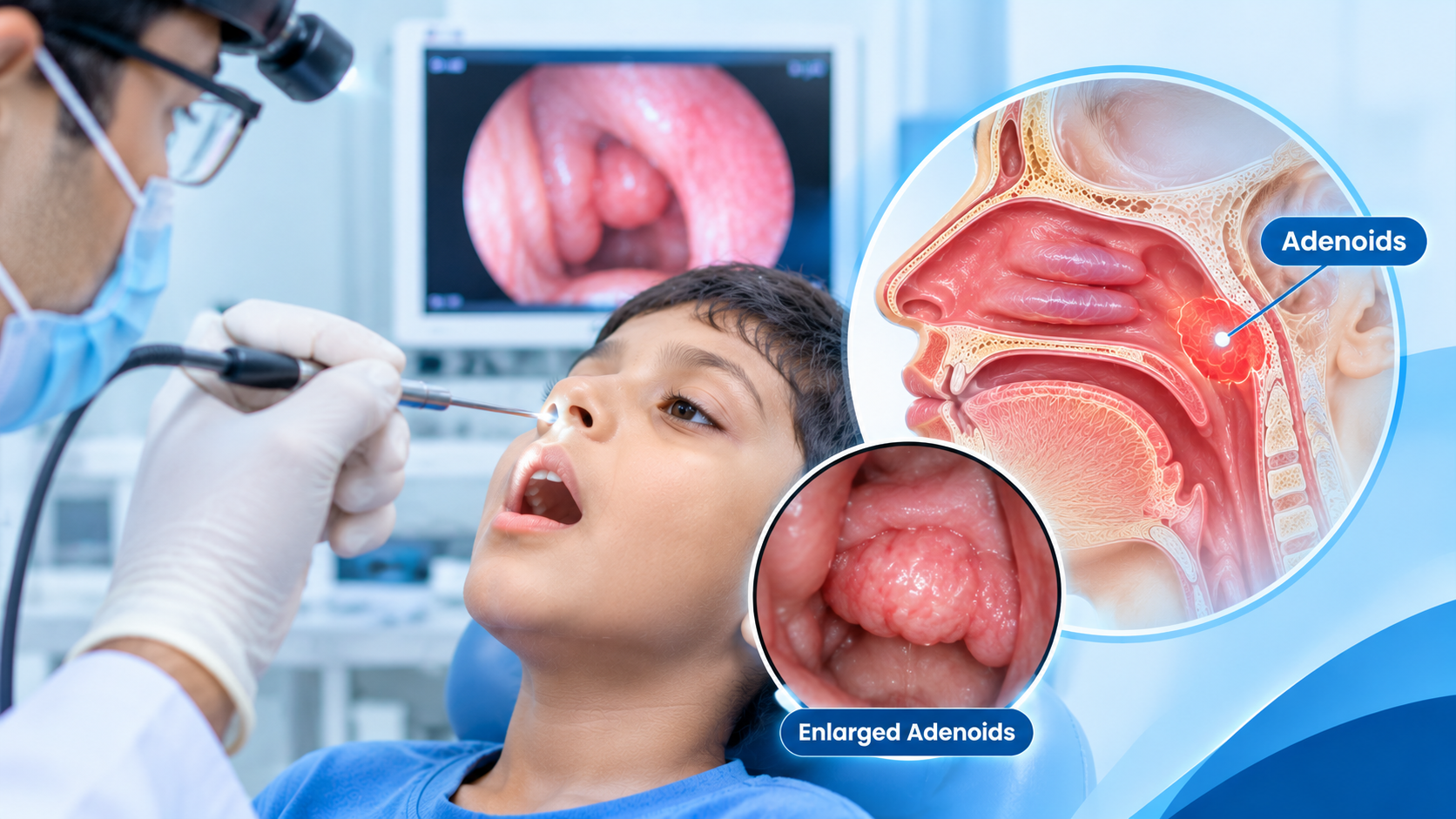
Why adenoids are different
Adenoids are soft tissue at the back of the nasal cavity, behind the nose. You cannot see them by looking into the nostrils, and they are mostly relevant to children, whose adenoids are naturally larger. Enlarged adenoids can block the airway behind the nose and are a common reason for a child’s persistent blocked nose, mouth breathing and snoring.
They are assessed by an ENT specialist, often with a nasal endoscope or imaging, so a child with these signs should not be treated by guesswork.
Blocked Nose at Night, Without a Cold, or on One Side
The pattern of your symptoms gives your ENT specialist useful clues.
Nasal congestion at night
Lying down increases blood flow to the nose lining, so a partly blocked nose often feels worse in bed. Allergy to dust mites, dry air and swollen turbinates can all play a part. Night-time blockage with loud snoring or pauses in breathing should be assessed.
Nasal congestion without a cold
Blockage that lasts with no fever or sore throat often points to allergy, non-allergic rhinitis, swollen turbinates, a septal problem or polyps. Frequent use of decongestant nose drops can also worsen blockage over time (rebound congestion).
Blocked on one side only
The two sides of the nose take turns being slightly more open, which is normal. A side that stays blocked for weeks suggests a structural cause such as a deviated septum or enlarged turbinate. One-sided blockage with bleeding, foul-smelling discharge or facial swelling needs prompt examination.
A child with a blocked nose
Mouth breathing, snoring, a constantly runny nose or repeated ear problems may be linked to enlarged adenoids, allergy or infection. In a young child, one-sided blockage with foul-smelling discharge can mean an object in the nose. Please do not give nose drops or medicines without a doctor’s advice.
How Is Nasal Congestion Diagnosed?
Your ENT specialist works out why your nose is blocked before recommending treatment.
History and symptoms
We ask how long the blockage has lasted, which side is affected, what triggers it, how you sleep, and which nose drops or sprays you have used.
Examination of the nose
A careful look inside the nostrils to check the lining, the septum and the turbinates.
Nasal endoscopy when appropriate
A thin, lighted scope can give a clearer view of areas that cannot be seen with the naked eye, such as the back of the nose.
Tests only when needed
Allergy testing, imaging or other tests are advised only when they will help decide your treatment.
Learn more about our diagnostic and specialised services.
Treatment Options for a Blocked Nose
Treatment depends on the cause. Many people improve with medical care, and surgery is for selected cases.
Treating the cause
Controlling allergy, avoiding triggers, and treating infection or sinusitis when they are the reason for the blockage.
Medical management
Saline rinses, and prescription nasal sprays or antihistamines when suitable. Please avoid long-term use of decongestant drops unless your doctor advises it — they can make blockage worse.
Procedures for structural causes
A deviated septum, polyps or enlarged adenoids may be treated surgically in selected patients after assessment. See our ENT surgery list.
Turbinate reduction
Considered when swollen turbinates remain the main cause of blockage despite proper treatment. Read more below.
This is general information, not a diagnosis. Please do not start or stop any medicine without medical advice.
Turbinate Reduction Surgery: When Is It Considered?
Turbinate reduction is a procedure that reduces the size of enlarged inferior turbinates to improve airflow through the nose. It is usually discussed only after medical treatment has been tried properly and examination shows that swollen turbinates are a main cause of the blockage.
Different techniques exist. Some use heat energy (such as radiofrequency or laser) to shrink the soft tissue, while others remove a small part of the turbinate tissue. The right approach depends on your anatomy and your surgeon’s assessment.
Turbinate reduction aims to open the airway. It does not cure allergy, some people still need medicines afterwards, and results vary — so we never promise a particular outcome. A specialist assessment comes first.
Turbinate reduction may be discussed if…
- Blockage continues after proper medical treatment
- Examination shows enlarged turbinates are a main cause
- Other causes — a bent septum, polyps, allergy — have been checked or are being treated
- You have been told the benefits, limits and risks, and what recovery involves
When Should You See an ENT Specialist?
These signs suggest it is time for a proper ENT evaluation.
Blockage lasting more than 10 days
A blocked nose that does not clear, or keeps coming back.
One side always blocked
Persistent one-sided blockage, especially with bleeding or discharge.
Poor sleep and snoring
Night-time blockage, loud snoring or restless sleep.
Reduced sense of smell
Smell that fades, with or without a blocked nose.
Frequent sinus trouble
Repeated facial pressure, discharge or sinus infections.
A child’s mouth breathing
Snoring, mouth breathing or repeated ear problems in a child.
Seek urgent medical care instead of waiting for a routine visit if you have:
- Severe difficulty breathing
- A nosebleed that is heavy or does not stop
- Swelling of the face or around the eyes
- A fleshy lump in the nose that bleeds easily or keeps growing
Why Choose Malleus ENT for Nose Care in Dhaka?
Focused ENT care at a specialised hospital at 24/1 Shan Tower (4th Floor), Shantinagar, Dhaka-1217.
Dedicated ENT care
A hospital focused on ear, nose, throat and head-neck conditions.
Experienced ENT specialists
Care led by qualified ENT and head-neck surgeons.
Diagnostic facilities in the hospital
Examinations and tests available within the hospital.
Patient-centred consultation
Clear explanations and time for your questions.
Medical to surgical care
From consultation and tests to medical and surgical treatment.
Follow-up support
Guidance after treatment to monitor your progress.
Consult our nose and sinus specialists — see the full doctor list or visit our contact page for directions.
Frequently Asked Questions
Quick answers to common questions about a blocked nose and enlarged turbinates.
What causes a blocked nose that does not go away?
Long-lasting blockage is often caused by allergic or non-allergic rhinitis, enlarged turbinates, a deviated septum, nasal polyps, chronic sinus problems or, in children, enlarged adenoids. Overuse of decongestant nose drops can also keep the nose blocked. An ENT examination identifies which one applies to you.
Is “extra flesh in the nose” the same as a nasal polyp?
Not necessarily. Many people who feel extra flesh in the nose have swollen turbinates, which are normal structures. Nasal polyps are soft swellings from the lining of the nose or sinuses, and enlarged adenoids sit behind the nose. Only an examination can tell them apart.
Are enlarged nasal turbinates dangerous?
Enlarged turbinates are not usually dangerous, but they can cause bothersome blockage, snoring and poor sleep. See a doctor promptly if you notice a lump in the nose that bleeds easily, keeps growing or comes with facial pain or swelling.
Do enlarged turbinates always need surgery?
No. Many people improve with treatment of the cause, such as allergy control, and with medicines prescribed by a doctor. A procedure is considered only if blockage persists despite proper treatment and examination shows the turbinates are a main cause.
Why is my nose more blocked at night?
When you lie down, blood flow to the nose lining increases, so a partly blocked nose often feels worse. Allergy to dust mites, dry air and swollen turbinates can contribute. If night-time blockage comes with loud snoring or pauses in breathing, please see an ENT specialist.
Can adenoids cause a child’s blocked nose?
Yes. Enlarged adenoids behind the nose are a common cause of persistent blockage, mouth breathing and snoring in children, though allergy and infection can look similar. A child with these signs should be examined by an ENT specialist before any treatment is started.
Is there a permanent treatment for a blocked nose?
It depends on the cause. Allergy-related blockage is usually controlled rather than cured. Structural problems such as a deviated septum may be corrected with surgery. Your ENT specialist can explain which approach is realistic for you after an examination.
Can I use nasal decongestant drops regularly?
Decongestant drops and sprays are meant for short-term use only. Using them for longer can worsen blockage (rebound congestion). If you have been using them for more than a few days, please ask a doctor before continuing.
নাকের ভিতরে মাংস বাড়লে কী করব?
অনেক সময় এটি নাকের টারবিনেট ফুলে যাওয়া হতে পারে। আবার নাকের পলিপ, শিশুদের অ্যাডিনয়েড বা নাকের হাড় বাঁকা থাকাও হতে পারে। কারণ ভিন্ন হলে চিকিৎসাও ভিন্ন হয়, তাই নিজে নিজে ওষুধ শুরু না করে নাক-কান-গলা বিশেষজ্ঞকে দেখিয়ে নিন। নাকের ভিতরে মাংসের মতো কিছু সহজে রক্ত পড়লে, ক্রমে বড় হলে বা মুখে ব্যথা ও ফোলা থাকলে দ্রুত পরীক্ষা করান।
নাক বন্ধের স্থায়ী চিকিৎসা কি আছে?
এটি কারণের ওপর নির্ভর করে। অ্যালার্জিজনিত নাক বন্ধ সাধারণত নিয়ন্ত্রণে রাখা যায়। নাকের হাড় বাঁকা থাকলে বা টারবিনেট বড় হয়ে থাকলে প্রয়োজনে অপারেশনের কথা বিবেচনা করা হয়। কোন চিকিৎসা উপযোগী তা পরীক্ষার পর বিশেষজ্ঞ ঠিক করেন।
নাক বন্ধ হলে কোন ডাক্তার দেখাবেন?
নাক দীর্ঘদিন বন্ধ থাকলে বা বারবার ফিরে এলে নাক-কান-গলা (ইএনটি) বিশেষজ্ঞকে দেখানো ভালো। ডাক্তার নাক পরীক্ষা করে কারণ নির্ণয় করবেন। দীর্ঘদিন নাকের ড্রপ বা স্প্রে ব্যবহার করে থাকলে তা ডাক্তারকে জানান।
How can I book an appointment?
You can book through our appointment page or call 09613-651020.
Blocked Nose That Won’t Go Away? Talk to an ENT Specialist
Book an appointment at Malleus ENT Specialized Hospital, 24/1 Shan Tower (4th Floor), Shantinagar, Dhaka-1217 — or call us to speak with our team.
