

Nasal Polyp Treatment in Dhaka
Nasal Polyp Treatment in Dhaka
A blocked nose that never fully clears, a fading sense of smell or a constant feeling of pressure in the face can be signs of nasal polyps. These soft, painless swellings in the lining of the nose and sinuses are usually not cancerous, but they tend to keep growing or returning when the inflammation behind them is not managed. At Malleus ENT Specialized Hospital in Shantinagar, Dhaka, our ENT team examines your nose, looks for the cause of your symptoms and explains whether medicines, regular follow-up or, where appropriate, surgery is the right next step. This guide explains nasal polyps in plain language so you know what to expect before your visit.
Nasal polyps can usually be managed. An ENT examination is the first step.

Nasal Polyps at a Glance
Nasal polyps are soft, painless, non-cancerous swellings that form in the lining of the nose or sinuses, usually because of long-lasting inflammation. Small polyps may cause no symptoms at all; larger ones can block airflow and sinus drainage. Here is the short version before the detail.
What they are
Soft, teardrop-shaped swellings of the nasal or sinus lining, linked to long-term inflammation rather than to something you did.
Common symptoms
A blocked nose, runny nose, postnasal drip, reduced smell and taste, facial pressure and snoring are the most common signs.
Are they cancer?
Nasal polyps are generally benign (non-cancerous). A growth on one side only, or one that bleeds, should be examined promptly to rule out other causes.
When to get assessed
See an ENT specialist if blockage or reduced smell lasts for several weeks, keeps returning or is getting worse.
What Are Nasal Polyps?
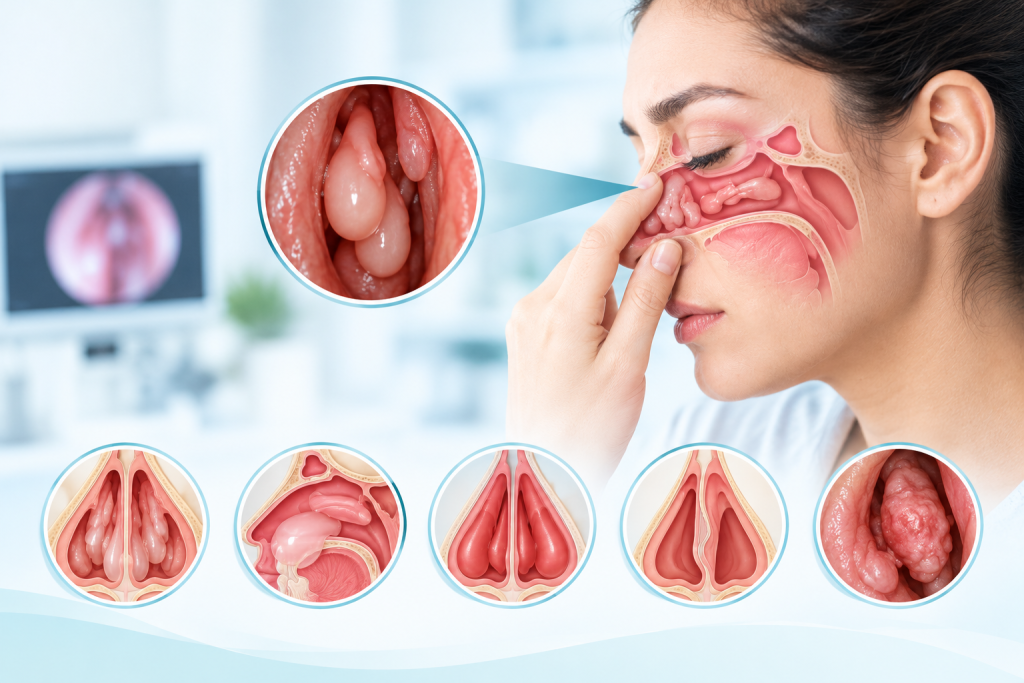
Nasal polyps (নাকের পলিপ) are soft, jelly-like swellings that develop on the lining of the nose and the air-filled sinuses around it. They often look like small teardrops or grapes and hang from the inside wall of the nasal passages. They are painless in themselves, which is why many people only notice them once the nose becomes blocked or the sense of smell fades.
Polyps form when the lining of the nose stays inflamed for a long time and becomes swollen and fluid-filled. Doctors usually call the condition chronic rhinosinusitis with nasal polyps. Small polyps may never cause trouble. Larger or multiple polyps can block the nasal passages and the openings of the sinuses, which affects breathing, smell and sinus drainage.
Types of nasal polyps
ENT specialists describe a few patterns. Ethmoidal polyps usually affect both sides of the nose and are the common form in adults. Antrochoanal polyps usually arise from the maxillary sinus on one side and are seen more often in children and young people. Your doctor identifies the type by examination.
Is it a polyp or something else?
Not every swelling in the nose is a polyp. Many patients are told they have “nose flesh” (নাকে মাংস), but the cause can be one of several different problems that need different treatment:
- Enlarged turbinates: normal structures inside the nose that swell with allergy or infection.
- Enlarged adenoids: tissue behind the nose, mostly in children.
- Deviated septum: a bent wall between the two nostrils.
- Other growths: uncommon growths, including rare tumours, which usually affect one side only and need a biopsy.
This is why an examination matters before any treatment is chosen.
Why Do Nasal Polyps Form?
The exact cause is not fully understood. Most nasal polyps are linked to long-lasting inflammation of the nasal and sinus lining, and several conditions make that inflammation more likely. Having a risk factor does not mean you will develop polyps, and many people with polyps have no obvious trigger.
Chronic sinus inflammation
Ongoing swelling of the nose and sinus lining (chronic rhinosinusitis) is the most common background. Polyps are thought to develop where this inflammation lasts for months.
Asthma
Asthma and nasal polyps often occur together because both involve inflammation of the airway lining. If you have asthma, persistent nasal symptoms deserve an ENT check.
Allergies
Allergic rhinitis is common in people with polyps, although allergy is not the cause in every patient. Managing allergy can help reduce nasal inflammation.
Aspirin and painkiller sensitivity
Some people develop nasal polyps, asthma and breathing reactions to aspirin or related pain relievers. If a painkiller worsens your breathing, tell your doctor.
Repeated infections
Frequent sinus infections are common in people with polyps. Blocked drainage can lead to infection, and infection can in turn keep the lining inflamed. Rarely, allergic fungal sinus disease is involved.
Family history and other conditions
A family history and certain medical conditions, such as cystic fibrosis, raise the likelihood. Polyps are uncommon in children, so a child with polyps needs a careful specialist assessment.
Note: Nasal polyps are not caused by something you did wrong, and they are not contagious.

Nasal Polyp Symptoms
Symptoms depend on the size and number of polyps. Small polyps may cause nothing. As they grow, they obstruct airflow and the drainage channels of the sinuses, and symptoms usually build up gradually over weeks or months rather than overnight.
Both nostrils are usually affected. Symptoms on one side only are different and should be checked sooner, because other conditions can look similar.
Blocked or stuffy nose
A feeling that the nose is always partly or completely blocked, often on both sides, that does not clear well with usual cold or allergy remedies.
Runny nose and postnasal drip
Clear or thick discharge from the nose, or mucus running down the back of the throat, which can cause throat clearing and cough.
Reduced smell and taste
Smell often fades first, and food can taste dull because taste depends heavily on smell. Loss of smell is one of the most typical signs.
Facial pressure and headache
A sense of heaviness or pressure around the cheeks, forehead or between the eyes, sometimes with a headache.
Snoring and mouth breathing
Nasal blockage can cause snoring, a dry mouth on waking, poor sleep and daytime tiredness.
Repeated sinus infections
Blocked sinus openings can lead to repeated or lingering sinus infections with pressure, discharge and sometimes fever.
Many of these symptoms also occur with colds, allergy or a deviated septum, so the symptoms alone cannot confirm polyps. An examination is needed.
How Are Nasal Polyps Diagnosed?
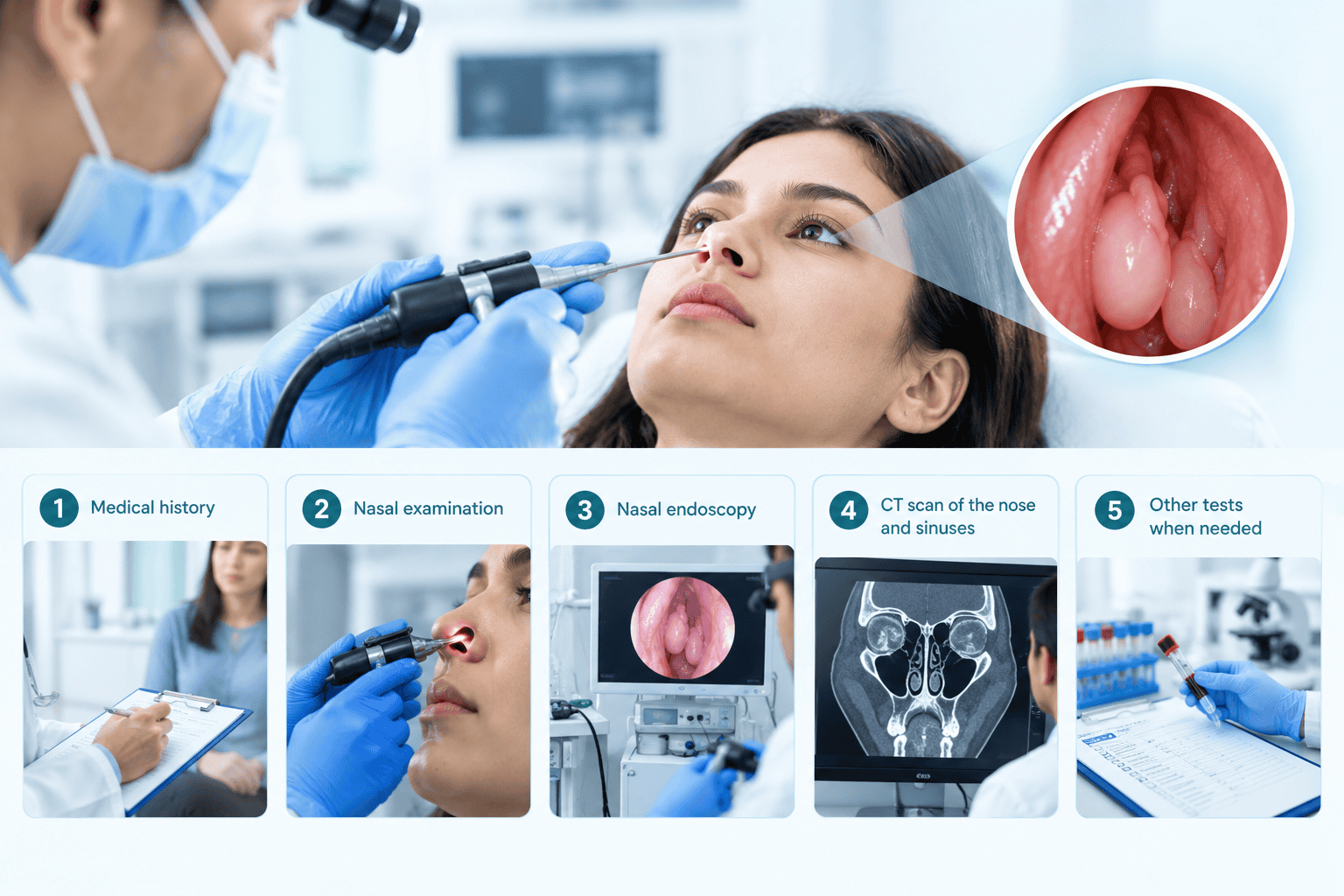
An ENT specialist can usually recognize nasal polyps by looking inside the nose. The aim of the assessment is not only to confirm polyps but also to understand why they formed and how far they extend.
1. Medical history
Your doctor asks how long the symptoms have lasted, which side is affected, how your sense of smell has changed, and whether you have allergy, asthma, previous sinus infections or nasal surgery, or reactions to aspirin or painkillers. Please bring your medicine list and any previous reports.
2. Nasal examination
A first look inside the nose with a light may show polyps near the front of the nose. Polyps higher up or deeper in the nose and sinuses are not always visible this way.
3. Nasal endoscopy
A thin endoscope with a light and camera lets the doctor see the polyps, their position and the sinus openings clearly. It is typically done in the clinic after the nose is prepared with a decongestant or numbing spray, and takes only a few minutes.
4. CT scan of the nose and sinuses
A CT scan is not needed for every patient. It is most useful when surgery is being considered, when medicines have not worked, when the diagnosis is uncertain or when complications are suspected. It shows how far the disease extends and maps the sinus anatomy for the surgeon.
5. Other tests when needed
Allergy testing, a smell assessment, review of asthma control, or a small tissue sample (biopsy) from a growth that looks unusual or affects one side only. Not every patient needs these.
Please ask the hospital which examinations and tests are currently available for your situation. You can also read about our Diagnostic & Specialized Services.
Nasal Polyp Treatment Options
There is no single treatment for every patient. The aims are to reduce inflammation, shrink or remove polyps, relieve symptoms and lower the chance of them returning. Most people start with medicines; surgery is usually reserved for people whose symptoms continue despite proper medical treatment or whose polyps are large. Every option below needs an ENT assessment first, so the choice fits your situation.
Nasal steroid sprays and drops
Corticosteroid sprays (or, for some patients, drops) are the main treatment. They reduce inflammation in the lining and can shrink polyps and ease blockage, discharge and sometimes smell. They work gradually, must be used regularly with the right technique, and are not effective for everyone.
Steroid sprays are different from decongestant sprays, which should not be used for more than a few days. Ask your doctor which product suits you and for how long.
Saline irrigation
Rinsing the nose with salt water clears mucus, crusts and allergens and helps medicines reach the lining. It does not remove polyps but often improves comfort.
Use boiled-and-cooled or distilled water, never untreated tap water, and clean the bottle after each use.
Selected oral medicines
A short course of steroid tablets, usually around one to two weeks, may be prescribed for some patients with significant blockage. These tablets have side effects and are not suitable for everyone, for example people with diabetes, high blood pressure or stomach ulcers need particular care, so they should only be taken on a doctor’s advice.
Antibiotics do not shrink polyps. They are used only when a bacterial infection is suspected.
Managing related conditions
Allergic rhinitis, asthma and aspirin sensitivity can all keep the nose inflamed. Controlling them, with allergy treatment, avoiding known triggers and keeping asthma treatment on track, supports polyp treatment.
Tell your ENT specialist and any other doctor treating you about each other’s medicines.
Endoscopic surgery
Surgery may be recommended when polyps are large, when symptoms persist after an adequate trial of medicines (clinical guidance often mentions around ten weeks or more), or when there are repeated infections or complications.
Modern surgery is done through the nostrils with an endoscope, so there are no cuts on the face. The surgeon removes polyps and, where needed, opens the sinus drainage pathways (functional endoscopic sinus surgery, FESS). Surgery clears the polyps but does not cure the underlying inflammation, so spray treatment usually continues afterwards.
Malleus ENT lists Nasal Polypectomy and FESS among its ENT surgeries; see the full ENT Surgery List.
Long-term management
Because the inflammation tends to return, most people benefit from long-term maintenance: usually a steroid nasal spray, regular rinses, control of allergy and asthma, and scheduled follow-up visits, sometimes with repeat nasal endoscopy.
Your ENT specialist adjusts this plan according to your symptoms and examination.
Disclaimer: Asthma and steroid medications should only be used as prescribed by your doctor. Avoid self-medication.
Good to know before you start treatment
- Treating every blocked nose as a “polyp” without an examination can lead to the wrong treatment.
- Please do not start, stop or change prescription medicines on your own.
- In some countries, injectable biologic medicines are used for severe polyps that keep returning despite surgery and steroids. Whether they are suitable, available and affordable in Bangladesh is a question for your ENT specialist.
Medication Versus Surgery
Medicines and surgery are not rivals. Most people begin with medicines, and many who have surgery still need medicines afterwards. The table gives a general comparison; your own plan depends on your individual clinical assessment.
| Aspect | Medical treatment | Endoscopic surgery |
|---|---|---|
| Main purpose | Reduce inflammation, shrink polyps and control symptoms. | Remove polyps and open sinus drainage pathways so medicines can reach the lining. |
| May suit | Most people at first, particularly with small to moderate polyps. | Large or blocking polyps, symptoms that continue despite proper medical treatment, repeated infections or complications. |
| Limitations | Works gradually and is not effective for everyone. Needs regular use. Polyps may regrow if treatment is stopped. | Does not cure the underlying inflammation, so polyps can return. Carries surgical and anaesthetic risks that your surgeon explains, and needs a recovery period. |
| Follow-up | A review after a trial period to check response and spray technique. | Planned post-operative visits, nasal cleaning or endoscopy, and ongoing medicines. |
| Role of ongoing medicine | The core of treatment. | Usually continues after surgery to reduce the chance of return. |
The right choice depends on your individual clinical assessment. Surgery is not always necessary, and medicines alone are not always enough.
Recovery Time: What to Expect
Recovery means different things depending on the treatment. Improvement with medicines, early recovery after surgery, returning to daily activities and complete internal healing all follow different timelines, and everyone heals differently. The descriptions below are general; they are not promises.

Improvement with medicines
Steroid sprays work gradually. Many people notice some improvement over the first few weeks, while the full effect on polyps and smell can take longer and varies from person to person. A short course of steroid tablets can act faster. Your doctor reviews your response after a trial period.
Early recovery after surgery
In the first days to weeks the nose is usually blocked, with crusting and blood-stained or watery discharge as the lining heals. Your surgeon explains saline rinses, medicines, and what to avoid, such as blowing the nose or heavy straining, for a period.
Return to normal activities
Many people return to light daily activities or desk work within roughly one to two weeks, but this varies with the extent of surgery, the kind of work you do and how you heal. Your surgeon advises on exercise, travel and heavy work.
Complete healing and follow-up
Feeling well enough for daily life is not the same as complete internal healing. The lining can take several weeks to a few months to settle, and follow-up visits are important. Sense of smell may improve, but in some people it stays reduced.
Disclaimer: Asthma and steroid medications should only be used as prescribed by your doctor. Avoid self-medication.
Can Nasal Polyps Come Back?
Yes, they can. Nasal polyps reflect ongoing inflammation, and treatment, including surgery, controls the polyps but does not remove the tendency to form them. The NHS notes that polyps commonly grow back, often within a few years after surgery, and that a steroid nasal spray may need to continue to stop them returning quickly.
Some people stay well for years on a spray alone; others need repeat treatment. Regrowth does not mean the earlier treatment was wasted. It means the condition needs long-term care, like asthma or allergy.
What helps lower the chance of return
- Use the prescribed spray regularly and with the correct technique.
- Continue saline rinses if your doctor advises them.
- Keep allergy and asthma well controlled.
- Avoid triggers that worsen your nose, such as smoke and known allergens.
- Attend follow-up visits even when you feel well.
- Report returning blockage or loss of smell early.
Disclaimer: Asthma and steroid medications should only be used as prescribed by your doctor. Avoid self-medication.
When Should You See an ENT Specialist?
Do not wait for symptoms to become severe. Persistent nose and smell problems are worth an ENT assessment, and a small number of warning signs need care without delay.
Book an ENT consultation if you have
- A blocked or runny nose lasting for several weeks.
- A reduced or lost sense of smell or taste.
- Facial pressure or repeated sinus infections.
- Snoring, mouth breathing or poor sleep because of nasal blockage.
- Symptoms returning after treatment or surgery.
- Persistent nasal blockage in a child.
- Asthma that seems to worsen with nose symptoms.
- Blockage or a growth on one side of the nose only.
Seek urgent medical care if you have
- Swelling or redness around the eye or forehead.
- Double vision, other vision changes, or an eye that looks pushed forward.
- A severe headache with fever, neck stiffness or confusion.
- A heavy nosebleed that does not stop with firm pressure.
- Severe difficulty breathing.
These are uncommon, but they need prompt care at the nearest emergency department rather than a routine appointment.
Nasal Polyp FAQs
Answers to the questions patients ask most often. They are general information, not a diagnosis.
Are nasal polyps cancerous?
Nasal polyps are generally benign, which means non-cancerous. However, not every growth in the nose is a simple polyp. A growth on one side only, one that bleeds easily, or one that comes with facial numbness, eye or vision changes or rapid growth should be examined promptly and may need a biopsy or scan. Your ENT specialist decides this by examination.
What causes nasal polyps?
Most nasal polyps are linked to long-lasting inflammation of the nose and sinus lining. Asthma, allergy, sensitivity to aspirin and similar painkillers, repeated sinus infections, a family history and some medical conditions such as cystic fibrosis are associated with them. In many people no single trigger is found.
Can nasal polyps disappear without treatment?
Nasal polyps rarely disappear on their own because they reflect ongoing inflammation. Symptoms may rise and fall, for example during colds or allergy seasons, but persistent blockage or loss of smell deserves assessment. Small polyps sometimes shrink with steroid spray.
Can medicines treat nasal polyps without surgery?
Often, at least in part. Steroid sprays or drops, saline rinses and, for some people, a short course of steroid tablets can shrink polyps or relieve symptoms. Medicines are not effective for everyone, and large polyps may not respond fully. People who do not improve may be considered for surgery.
When is surgery recommended?
Surgery is usually considered when symptoms continue after an adequate trial of medical treatment, when polyps are large or blocking the sinuses, or when there are repeated infections or complications. Your ENT specialist bases the decision on your symptoms, examination, scan findings where needed and your preferences. Surgery is not always necessary.
How is nasal polyp surgery done?
It is usually done endoscopically, through the nostrils, so there are no cuts on the face. The surgeon removes the polyps and, where needed, opens the sinus drainage pathways. Your surgical team explains the type of anaesthesia, whether a hospital stay is needed, the risks and the aftercare before you decide.
How long does recovery take?
It depends on the treatment and the person. With medicines, improvement is usually gradual over weeks. After surgery, many people return to light activities or desk work within about one to two weeks, while the inside of the nose can take several weeks to a few months to heal fully. Your surgeon gives personal advice, and there is no fixed timeline for everyone.
Can nasal polyps come back?
Yes. Polyps can regrow after medicines are stopped or after surgery, often within a few years. Regular use of the prescribed spray, control of allergy and asthma, and follow-up visits lower the chance of return but cannot guarantee that polyps will not come back.
Do nasal polyps affect the sense of smell?
Yes. Reduced or lost smell is one of the most typical symptoms, because polyps block airflow to the smell area high in the nose. Smell often improves with treatment, but recovery is not certain, particularly when smell has been lost for a long time.
What tests may be needed?
Most people need a history and a nasal examination, often with nasal endoscopy. A CT scan is usually reserved for people being considered for surgery, those who have not responded to medicines, or when the diagnosis is uncertain. Allergy tests, a smell assessment or a biopsy are used only when needed.
How much does nasal polyp treatment cost in Bangladesh?
The cost depends on the treatment you need and varies from person to person. Factors include the tests required (such as endoscopy and CT), whether you need medicines only or surgery, the extent of surgery, the type of anaesthesia, the room or cabin type and length of stay, medicines, and the number of follow-up visits. This page does not list a fixed price. For a current estimate for your situation, contact Malleus ENT on 09613-651020 or book a consultation.
Is a nasal polyp the same as “nose flesh”, enlarged turbinates or adenoids?
No. People often use “nose flesh” (নাকে মাংস) for several different problems. Nasal polyps are soft inflamed swellings of the lining; turbinates are normal structures that can become enlarged; adenoids are tissue behind the nose, mostly affecting children. They are treated differently, so an examination is important.
Are there home remedies for nasal polyps?
No home remedy has been shown to remove nasal polyps. Saline rinses with safe water can ease symptoms and are often recommended alongside medicines. Steam, herbal or dietary remedies may feel soothing but should not delay a proper examination, especially if symptoms are persistent.
Can children get nasal polyps?
Nasal polyps are uncommon in children. A blocked nose in a child is more often caused by enlarged adenoids or allergy. When polyps are found in a child, doctors look carefully for causes such as cystic fibrosis, and a single-sided polyp-like growth needs specialist assessment.
When should I see an ENT specialist?
See an ENT specialist if a blocked nose, runny nose or reduced smell lasts for several weeks, keeps returning, or is getting worse, or if you have blockage on one side only. Seek urgent care for eye swelling, vision changes, severe headache with fever, heavy bleeding or severe breathing difficulty.
Get a Blocked Nose or Reduced Smell Checked
An ENT examination can confirm whether you have nasal polyps, look for what is behind them and explain your treatment options clearly, including whether you need medicines, follow-up or surgery. Book an appointment at Malleus ENT Specialized Hospital, 24/1 Shan Tower (4th Floor), Shantinagar, Dhaka-1217.
For hospital hours and directions, see our Contact page. You can also view our doctors.
Medical Disclaimer
This page provides general educational information about nasal polyps. It does not replace professional medical advice, examination, diagnosis or treatment. Symptoms, risks and recovery vary from person to person, and the information here may not apply to your situation. Do not start, stop or change any medicine without consulting a qualified doctor. If you think you have a medical emergency, go to the nearest emergency department. General information on this page draws on guidance from the NHS and published ENT clinical guidelines.
